1. Start with the region and the purpose of the trip
The best time to visit India depends on which India you intend to experience. A fort-and-palace route through Rajasthan, a Kerala backwater stay, a coastal city break and a Himalayan journey have different weather sensitivities. Rather than asking for one national best month, identify your essential experience and the conditions that would prevent you enjoying it. That creates a much more useful starting point.
Separate comfort from access. Warm weather might merely shorten a city walk, while heavy rain or snow can affect whether a road, trail or boat journey operates at all. Give the most weather-sensitive part of the route priority when choosing dates. Then add compatible city stops, rather than choosing a convenient international arrival date and trying to force every region into the same seasonal assumption.
2. Compare existing city data without inventing a national average
Start with the site's Delhi best-time page, Mumbai best-time page and Chennai best-time page when those cities form part of your route. Compare temperature patterns and rainfall information for the months you are considering. These are historical planning tools, not forecasts for a particular travel week.
Do not transfer a city's chart to an entire state or a mountain destination. Mumbai is not a numerical stand-in for all western India, and Delhi cannot describe conditions at elevation. Where a specific destination is not linked here, use official regional information and local forecasts. A gap in available data should remain an acknowledged gap, not become a confident-looking estimate borrowed from somewhere geographically convenient.
3. Northern plains and Rajasthan: plan for outdoor exposure
For Delhi, Agra and Jaipur, begin by comparing cooler-season dates against your tolerance for hot outdoor sightseeing. Forts, courtyards and archaeological complexes can involve substantial time outside, even when the attraction includes indoor rooms. Build the day around manageable walking blocks, shade and rest, rather than assuming that a full list of monuments fits comfortably into any season.
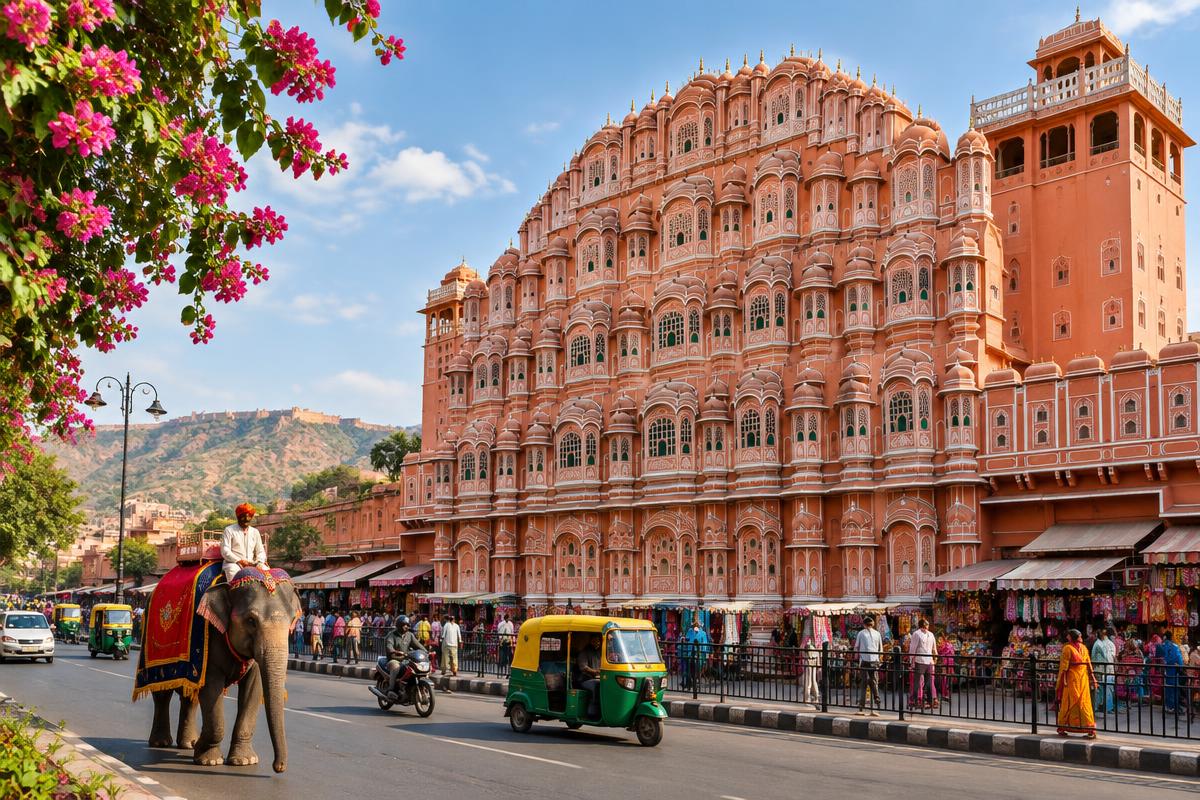
Rajasthan's official tourism coverage highlights places such as Amber Fort, Jaipur's Hawa Mahal and Udaipur's City Palace, illustrating how varied the sightseeing is across the state. The weather decision should be equally specific: a palace visit, desert excursion and lakeside stay do not have identical exposure or transport needs. Consult the official Rajasthan overview, then confirm individual attraction details separately.
4. Kerala: distinguish coast, backwaters and higher ground
Kerala Tourism describes a tropical climate with major southwest monsoon rainfall and a later northeast monsoon influence. It identifies December, January and February as generally pleasant months, while March to May can feel humid and sultry in coastal and midland areas. These are seasonal tendencies, not promises of dry days or a substitute for the conditions at your exact stop.
A Kerala itinerary may combine coastal accommodation, backwaters and higher terrain around Munnar. Pack and schedule these separately. A comfortable coastal evening does not describe an upland morning, while heavy rain can change the practical appeal of a long road transfer or outdoor excursion. Leave room to rearrange activities, and ask operators about current access and cancellation arrangements before paying for weather-dependent experiences.
5. Understand monsoon travel without romanticizing disruption
Kerala's official guidance explains that the southwest monsoon typically arrives in June and the northeast monsoon appears later, around October. It also acknowledges irregular rainfall and episodes of flooding. A green landscape and a good accommodation offer do not remove those operational risks. Treat wet-season travel as its own kind of holiday rather than a cheaper version of a dependable dry-weather beach itinerary.
Plan shorter transfers, weather-independent activities and more flexible bookings when rain is central to the season. A boat operator's cancellation is a reason to change plans, not to search for someone willing to ignore the conditions. Recheck local advice after substantial rainfall, especially before hill journeys or activities near rivers.
6. Treat the southeast coast and the Himalayas as separate decisions
Do not assume that the rain pattern you researched for the west coast settles the timing of a Chennai visit. Compare the Chennai historical view directly with Mumbai's and read the rainfall pattern across your candidate months. For a beach or marine activity, air temperature is only one consideration; local warnings, water conditions and operator advice remain decisive.
Mountain travel needs an even clearer separation from the plains. Elevation, snow, road conditions and your level of acclimatization affect what is realistic. A pleasant month in Delhi does not establish access to a high pass or suitability for a Himalayan trek. Use destination-specific official advice, allow recovery time after demanding transfers and avoid placing a major mountain objective immediately after arrival. Broad seasonal summaries cannot resolve a route-specific access question.
7. Compare seasonal questions rather than searching for one winner
This table summarizes planning priorities rather than assigning guaranteed conditions to calendar months. Kerala's seasonal distinction follows Kerala Tourism's climate guidance; the other rows show what to verify for each type of route.
Use it to identify the weakest link in a proposed itinerary. If every stop depends on different ideal conditions, simplify the route or accept that some experiences will be secondary. A trip with two compatible regions and spare time is often more satisfying than a country-spanning circuit designed around a misleading national season label.
| Route or region | Main seasonal question | Practical response |
|---|---|---|
| Delhi, Agra and Jaipur | Will outdoor sightseeing feel comfortable? | Compare cooler dates and keep midday flexible |
| Kerala coast and backwaters | How much rain and humidity suits the trip? | Check both monsoon influences and operator advice |
| Kerala higher ground | How do elevation and rain affect the stay? | Carry layers and verify road conditions |
| Mumbai and western coastal routes | Does the city's rainfall pattern suit the activities? | Read its own historical chart and local notices |
| Chennai and southeast routes | Does the regional rainfall pattern match your assumptions? | Compare Chennai separately from the west coast |
| Himalayan routes | Are roads and trails accessible and appropriate? | Use route-specific official information |
8. Worked example: a northern sightseeing route
Consider a first trip focused on Delhi, Agra and Jaipur. Start by comparing candidate cooler-season weeks on Delhi's historical page, then research the other stops individually. Give Delhi several nights so arrival fatigue does not compete with your longest walking day. Continue to Agra with a manageable sightseeing target, then allow Jaipur enough time for its major sights without making every transfer day a full touring day.
Putting the example into practice
This is a route structure, not a bookable timetable. Verify current train or road arrangements, attraction opening rules and any advance-entry requirements before fixing the order. Keep one substantial outdoor visit movable at each stop. If Kerala is also essential, give it a separate weather assessment and enough nights to justify the additional journey; do not add it simply because a national guide calls the same month ideal.
9. Match bookings and packing to the weakest-weather stop
Book the least flexible elements carefully: transport between distant regions, limited-entry attractions and any guided activity with seasonal operating constraints. Read change terms before assuming that a weather adjustment will be easy. Festivals and public holidays also need their own research, because a date that works climatically can still create a very different travel experience from an ordinary week.
Pack around the full route. Breathable clothing and sun protection may be relevant across several regions, but cool evenings, air-conditioned transport and higher ground can justify additional layers. Rain protection should remain accessible during a wet-season journey rather than buried in checked luggage. For religious sites, research current dress and access expectations separately; comfortable weather clothing is not automatically suitable for every place you intend to enter.
10. Turn seasonal research into a departure checklist
Several weeks or months ahead, choose the route using historical patterns and official regional guidance. Close to departure, switch to dated forecasts for each stop and review local notices. On the trip, keep checking before long transfers or exposed activities. The planning question changes over time: first ask whether the season fits, then whether the coming day fits.
Avoid interpreting a single wet icon as a cancelled holiday or a historically dry month as permission to ignore warnings. The objective is not to eliminate uncertainty but to make it manageable. Keep a slower day, an indoor alternative and a practical way to contact your accommodation or operator. These decisions protect the trip more effectively than searching for an exact national best month.
Before you go
- Choose regions and essential activities before choosing one national season.
- Compare Delhi, Mumbai and Chennai only for the destinations they represent.
- Research every additional region with official local sources.
- Account for both Kerala monsoon influences.
- Check mountain access independently of city weather.
- Confirm transport and attraction arrangements before fixing the sequence.
- Keep weather-dependent excursions changeable where possible.
- Pack for the coolest, wettest and most exposed stop.
- Review local warnings before transfers and outdoor activities.
Frequently asked questions
Is winter the best time to visit all of India?
No. Cooler months are a useful starting point for many northern sightseeing routes, but mountain access, tropical rain patterns and your planned activities require separate checks.
Can I visit Kerala during the monsoon?
Yes, if the trip is designed around wet conditions and current local advice. Do not treat a monsoon stay as equivalent to a reliable beach, trekking or boating holiday.
Does Delhi's weather represent a Himalayan destination?
No. Elevation, terrain, snowfall and road access can differ substantially. A city forecast is not an adequate safety assessment for a mountain route.
Which site destination pages should I compare?
Use the existing Delhi, Mumbai and Chennai pages for those cities. For destinations without a corresponding linked page here, consult official regional tourism and weather information rather than substituting another city's numbers.